
How it works
Each robot makes two choices: which task to work on, and what to share with its neighbors.
Follow one robot
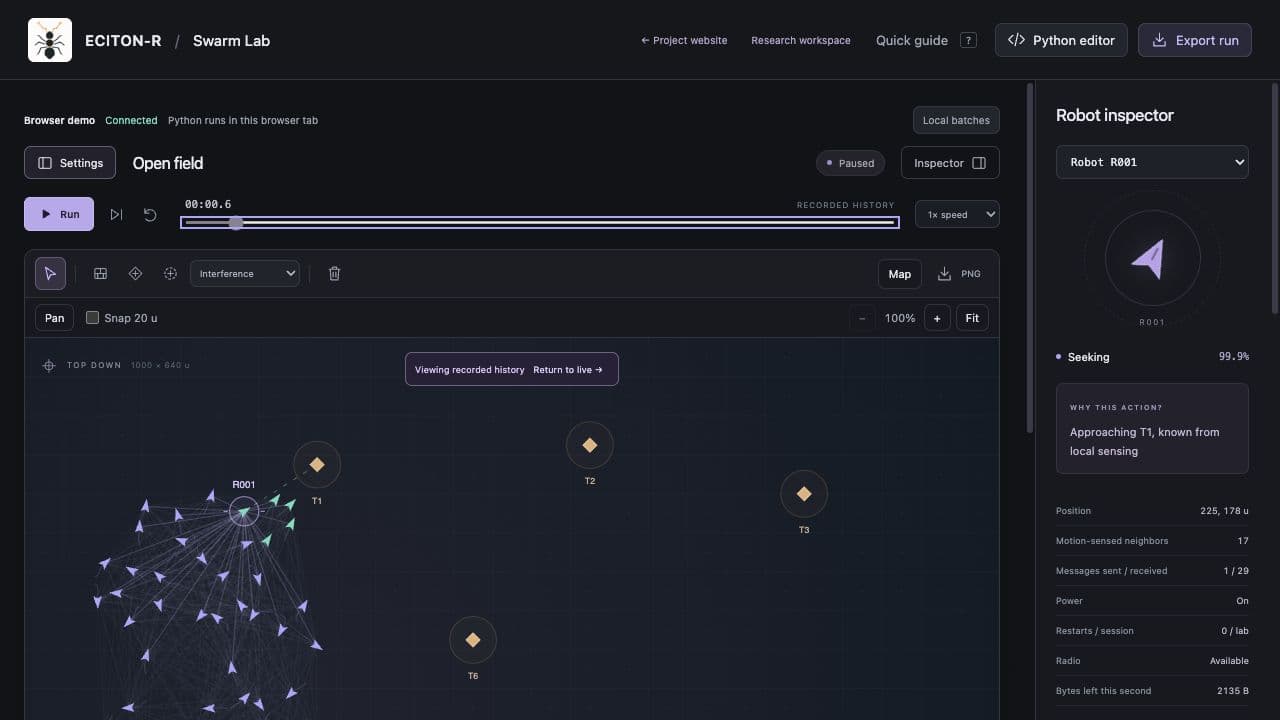
- 1. Find outHere, R001 discovers T1 through its own sensing. A robot can also learn about a task from a delivered message.
- 2. Choose workR001 picks T1 from its known tasks. The inspector shows its reason: “Approaching T1, known from local sensing.”
- 3. Pass it onThe sharing rule decides whether to send an update. A nearby robot learns from it only if the message is delivered and accepted.
Who controls what in the proposed Node
In the proposed Node, ECITON-R suggests tasks and handles communication. The host robot controls navigation, motors, obstacle avoidance, and safety.
Responsibility map
Follow either path to see what ECITON-R handles and where its authority ends.
- Host robotPermitted observation
The route ahead is blocked.
- ECITON-R nodeAdapter translates it
Only the approved observation enters the shared format.
- ECITON-R nodeTask preference
A different useful task is suggested.
- ECITON-R nodeCheck task intent
Unsupported, stale, or unsafe intent is blocked.
- Host robotAccept or reject
Navigation and safety software keep final authority.
Trace task intent
Example: A robot reports that its route ahead is blocked.
- What enters
- A permitted observation says that the current route is blocked.
- What ECITON-R decides
- It forms a task preference and checks that the intent is supported, current, and within bounds.
- What leaves
- A high-level task intent returns to the host robot. It is not a movement command.
- What can stop it
- Deterministic checks can block the intent. The host robot may still reject or ignore it.
Try this yourself: select a robot, open its inspector, then turn on Robot knowledge. Unknown tasks disappear from its view. Turn sharing off to explore what it can find on its own.
Explore the Node components
- Robot adapter
- Translates approved robot data into a shared format and returns high-level task suggestions.
- Decision logic
- Chooses a useful task and decides whether sending a message would help.
- Protocol services
- Checks identity, permissions, message versions, expiry, duplicates, and coordinator terms.
- Message router
- Builds a message with a purpose, priority, forwarding rule, and expiry time.
- Transport manager
- Chooses an available connection after the message passes its checks.
- Evidence recorder
- Records decisions, messages, delivery results, retries, task events, and run settings.