Swarm Lab now has task claims, multi-hop gossip, and temporary coordinators. Robots can reserve work and pass discoveries further through the team, while the inspector lets us check what each robot knows.
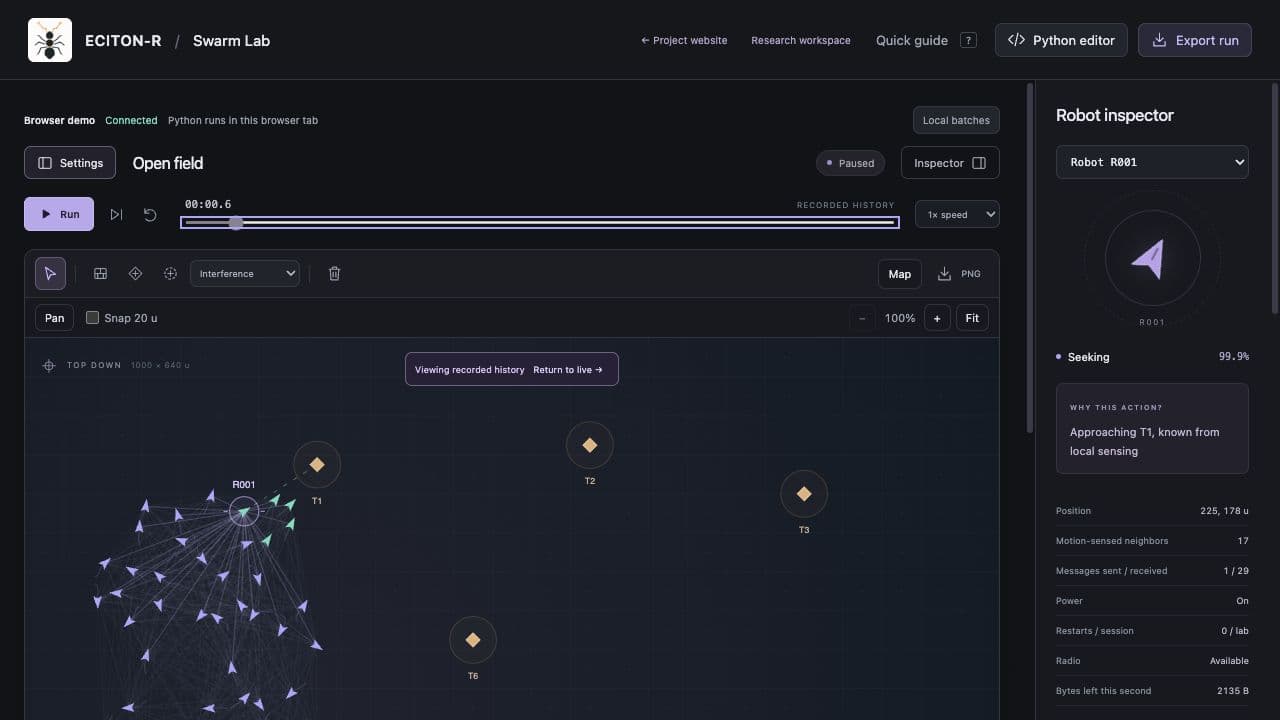 R001’s inspector reports that it is approaching T1, which it discovered through local sensing.
Illustration added October 4: a recorded Open field snapshot from the running simulator. R001’s reason is visible on the right. This scene shows local task choice; claims and coordinators are off in this setup.
What you can explore now
Task claims and reassignment. Robots can claim work, renew or release a claim, and resolve conflicting claims using deterministic rules. Claims expire, so a robot that disappears doesn't hold a task indefinitely. During a network split, competing claims can still exist; the simulator lets us examine that failure instead of assuming every robot agrees.
Gossip and temporary coordinators. Information can travel across multiple hops under byte and forwarding limits. Temporary coordinators can forward summaries, with finite terms and replacement rules. When leadership is unavailable, forwarding can fall back to individual robots. Sending more information still costs resources, and delivery is never assumed.
Different roles and repeatable worlds. Scout, worker, and relay profiles have different simulated capabilities. Seeded maps generate rooms, aisles, or open spaces, while workloads can introduce tasks over time. Fixed arrivals let us compare policies against the same incoming work; replenishing workloads let us explore sustained demand.
The browser remains a way to inspect individual robots, edit scenes, and follow packet activity. Local Native Python mode uses the same engine, and separate batch jobs can keep running after the browser closes. Saved runs retain their configuration, seeds, and software identity so we can trace what produced a result.
What we're working on right now
We’re connecting each robot’s decision code to its own observations and memory, then checking how its choices spend the message and computing allowances. The interfaces and accounting code have been checked separately; the complete path through the simulator is still being integrated.
A robot shouldn’t get an answer by looking at tasks it hasn’t sensed or heard about. That separation is what we need before comparing policies.
What's coming
The next mission slice is facility inspection: purposeful exploration, persistent local maps, routes around obstacles, inspection jobs, and a return-to-hub service and recharge cycle. Shared map updates should help robots use one another's discoveries, with findings reaching the dashboard through modeled delivery.
Alongside that, we're building toward stronger comparisons against deterministic baselines, followed by a compact learned policy that chooses task preferences and when to communicate. Aerial and mixed ground–air inspection are later steps.
Those features are planned. Today's movement, radio, and energy models remain abstractions, and we haven't established learned-policy improvements or physical robot performance. You can inspect the current rules in Swarm Lab.